Enchanting Fox Watercolour Junk Journal Pages for Crafting
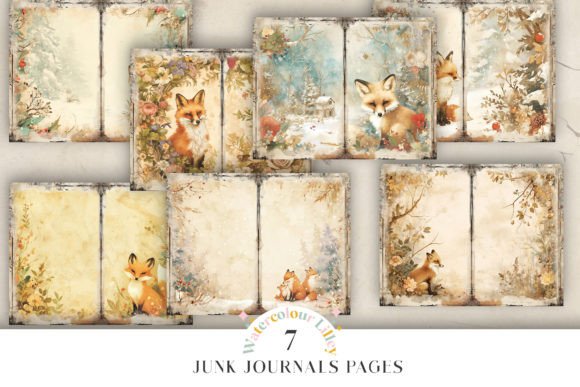
There is a specific kind of magic in the intersection of digital precision and organic artistry. When you download the Fox Watercolour Junk Journal Pages, you aren't just acquiring a set of printable papers; you are holding a key to a woodland narrative. As a designer and creative strategist, I view these assets not merely as "backgrounds," but as foundational design elements that set a distinct emotional tone. The seven-page collection, sized at a generous 11" x 8.5" and rendered in crisp 300dpi, offers a tactile quality that translates beautifully from screen to print. This is where the whimsy of a storybook meets the utility of serious design assets.
The Aesthetic Appeal: More Than Just Scrapbooking Paper
At first glance, these pages are undeniably charming, featuring watercolor foxes that seem to have wandered out of a Victorian field guide. However, looking closer through the lens of editorial design and branding, the appeal lies in the texture. Watercolor is notoriously difficult to digitize authentically. Often, digital brushes look flat or overly saturated. These pages, conversely, capture the "bloom" of pigment on wet paper, creating a soft, organic grain.
The color palette likely relies on earth tones—burnt sienna, slate grey, and forest green—anchored by the warm russet of the foxes. This creates a visual hierarchy that is soothing rather than jarring. For those of us working in modern typography, this is crucial. A busy background can kill a layout, but the inherent noise in a watercolor texture actually helps blend with text, provided the contrast is managed. It acts as a display font for your page layout; it shouts "nature" and "vintage" without saying a word.
Strategic Applications: From Brand Identity to Personal Projects
While the prompt suggests junk journaling, the utility of high-resolution, premium font-style assets like these extends far beyond the craft table. If you are an entrepreneur or a small business owner, consider the psychology of your brand. If your brand identity leans toward sustainability, organic goods, or artisanal craftsmanship, these fox pages are gold.
Imagine using a cropped section of one of these pages as a background texture for a website hero image. It immediately establishes a brand identity that is approachable and connected to nature. Or, consider packaging design. A small business selling handmade soaps or teas could use these pages as wrapping paper or sleeve inserts. It elevates the unboxing experience, turning a simple transaction into a sensory event.
For the content creators and marketers in the audience, think about social media graphics. In a sea of flat, corporate minimalism, a rich, watercolor background featuring a whimsical fox stops the scroll. It adds a layer of storytelling. You can overlay a sans serif font in white or charcoal for a striking contrast between modern readability and vintage aesthetics. This blend of the old and new is a powerful tool in visual hierarchy, guiding the viewer's eye exactly where you want it.
Practical Integration and Design Pairings
How do you practically integrate these pages into a professional workflow? It comes down to pairing. Because the Fox Watercolour Junk Journal Pages possess a strong, illustrative personality, they require a typographic partner that doesn't compete for attention.
- For Typography: Avoid overly ornate script fonts or complex handwritten fonts for body copy, as they will get lost in the watercolor texture. Instead, opt for a clean, geometric sans serif font. The sharp edges of a sans serif will cut through the soft watercolor bleed, ensuring readability. If you need a serif font, choose one with high contrast and distinct thick/thin strokes, like a Didot or Bodoni, to maintain elegance without muddying the text.
- For Layout: Use the 300dpi resolution to your advantage. You can zoom in on specific details—perhaps a single fox or a cluster of leaves—to create texture overlays. This is a common technique in logo design where a textured fill adds depth to vector shapes.
- For Licensing: Always verify the commercial font and asset licensing. Assuming these are offered for commercial use, they become a scalable asset for your business. You can use them in products you sell (like the journals) or marketing materials you distribute.
Elevating the Narrative: The Psychology of the Fox
Why a fox? In visual semiotics, the fox represents cleverness, adaptability, and a touch of playful mischief. Incorporating this imagery into your editorial design or personal projects communicates these traits to your audience. It suggests that your content is smart, agile, and engaging.
For bloggers and publishers, using these pages as a thematic backdrop for articles on mindfulness, nature, or storytelling creates a cohesive reading experience. It transforms a digital article into something that feels curated and "kept." This is the essence of the junk journal movement—it is about preserving stories and curating beauty. Even in a digital PDF or a printed booklet, the creative font of the imagery (the watercolor style) dictates the mood.
Final Thoughts on Utility
The true value of the Fox Watercolour Junk Journal Pages lies in their versatility. They are not just static images; they are design assets waiting to be manipulated, cropped, and layered. Whether you are a hobbyist creating a memory book for a loved one, or a designer developing a full brand identity for an eco-conscious client, this collection provides a solid, high-resolution foundation.
By treating these pages with the same respect you would a premium font or a vector kit, you unlock their potential. They offer a bridge between the analog warmth of a hand-painted illustration and the digital crispness required for modern web design and print production. Dive into the details, test your pairings, and let these woodland creatures guide your next creative project.