Number Book 1-20: A Practical Design Asset for Foundational Learning
In the world of early childhood education, the tools we choose to facilitate learning are just as critical as the curriculum itself. For designers, educators, and content creators specializing in children's products, the Number Book 1-20: Numbers Color, Tracing represents a specific solution to a common challenge: how to make the abstract concept of numeracy tangible, engaging, and accessible for the youngest learners. This workbook is not merely a collection of pages; it is a carefully structured design asset that blends pedagogical theory with practical, hands-on activity.
Visual Style and Core Characteristics
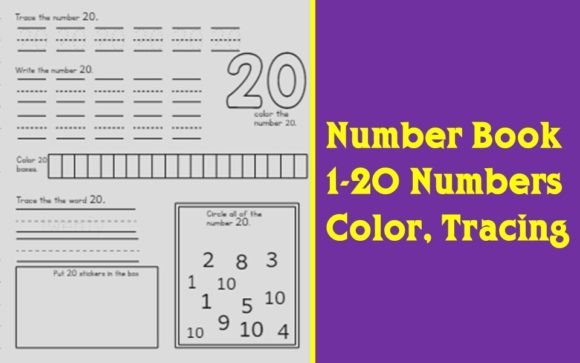
At its heart, the Number Book 1-20: Numbers Color, Tracing is built on a foundation of clarity and interaction. Its visual personality is friendly, approachable, and intentionally simplistic to avoid overwhelming developing minds. The layout prioritizes a clean visual hierarchy where the numeral is the undisputed hero of each page. The design style is distinctly modern typography applied to a classic workbook format—bold, sans-serif numerals are paired with whimsical, themed illustrations that are left uncolored, inviting participation. This approach respects the child's role as an active creator rather than a passive consumer.
The key features are thoughtfully integrated into the visual flow. Each number is introduced with its name, reinforced through a coloring activity that builds association, and then practiced via dotted-line tracing exercises. This sequence is a masterclass in user experience design for children. The dotted-line font used for tracing is not an afterthought; it is a purpose-driven typeface designed for motor skill development, with consistent stroke weight and optimal spacing to guide a small hand. The overall appeal is one of encouraging simplicity, making the daunting task of learning to write numbers feel like a series of achievable, playful steps.
Strategic Applications for Creative Professionals
For the audience of designers, entrepreneurs, and content creators, understanding the value of the Number Book 1-20: Numbers Color, Tracing extends beyond its direct use as a student workbook. It is a foundational piece within a larger ecosystem of educational design assets. Its strongest applications lie in projects where foundational literacy and numeracy are the core message.
- Publishing & Editorial Design: This workbook is ideal for publishers specializing in early learning materials. Its format can be directly adapted or used as a template for creating entire series covering letters, shapes, and words, ensuring brand consistency across a product line.
- Digital & Print Products: Entrepreneurs can leverage the book's format to create sellable digital downloads for platforms like Etsy or Teachers Pay Teachers. The print-ready design translates seamlessly from physical workbooks to printable PDF activity sheets, offering versatile product options.
- Brand Identity for Educational Services: A tutoring center, preschool, or educational blog can use the visual language of this book—its clean layout, friendly illustrations, and interactive elements—to build a cohesive brand identity. It communicates a philosophy of learning that is structured yet creative.
- Content Creation & Social Media Graphics: The individual number pages can be repurposed as engaging social media content. A quick video of a child completing a page, or a graphic highlighting a specific number, serves as valuable, authentic content for parenting and education influencers.
Influence on Learning Outcomes and User Engagement
The design choices within the Number Book 1-20: Numbers Color, Tracing directly influence key developmental outcomes. The high-contrast, uncluttered layout enhances readability for young eyes, allowing them to focus on the essential task. This careful attention to visual hierarchy ensures that the number itself commands attention, while the activity instructions remain clear but secondary.
From a brand perception standpoint, using a resource like this signals a commitment to quality and evidence-based design. For a teacher or parent, it builds trust and recognition. The consistency of the format—where every number is introduced in the same reliable way—reduces cognitive load and helps children build a predictable learning routine. This consistency is a cornerstone of effective educational design, fostering a sense of security and competence as the child progresses from 1 to 20.
Ultimately, the workbook's power lies in its ability to drive engagement. The act of coloring personalizes the learning experience, while the tracing provides the necessary repetition for muscle memory. This combination is far more effective than passive observation. For a content creator or marketer, this is a critical lesson: the most successful educational tools are those that transform the user from a spectator into a participant.
Practical Guidance for Implementation and Selection
When considering the Number Book 1-20: Numbers Color, Tracing for a project, whether as a final product or a design reference, a practical evaluation is key. First, assess the project's fit. Is the goal to teach number formation? Then the tracing component is non-negotiable. Is the goal to foster creativity alongside learning? The coloring illustrations are essential.
Next, consider font pairings and testing. While the book uses specific fonts for numbers and tracing, a designer creating a broader campaign might pair the workbook's friendly sans-serif display font with a complementary script or handwritten font for headers or parent-facing text. Always test these pairings for visual harmony and, most importantly, for readability. The tracing font must be evaluated for its dotted-line clarity—can a child easily distinguish the path?
Review the included styles and licensing. If adapting the design, ensure you have the right to use the illustration style and the tracing font in your commercial projects. The strength of this asset is its integrated design; breaking it apart requires careful consideration to maintain its educational integrity.
In practice, this means starting with the end-user in mind. Observe how a child interacts with a sample page. Does the size of the tracing area feel comfortable? Are the coloring illustrations simple enough to be satisfying but not so complex they cause frustration? These real-world observations are the most valuable part of the design process. The Number Book 1-20: Numbers Color, Tracing succeeds because it is built on this principle of empathetic, user-centered design, making it a robust and reliable resource for anyone dedicated to creating meaningful early learning experiences.